Free Christian Curriculum Kindergarten through twelfth grade · free to download

Grade 12 · 15 units · 180 lessons · 1,800 questions

Botany & Gardening

Plant families, soil life, and the Back to Eden method, from tomatoes and squash through herbs, berries, and companion planting.

Elective Self-paced. It is not part of the daily schedule, so it can be taken over a summer, spread across a year, or left out entirely.

About this course

Plant families, soil life, and the Back to Eden method, from tomatoes and squash through herbs, berries, and companion planting.

Botany & Gardening for Grade 12 runs to 15 units and 180 lessons, each closing with about 10 questions that grade themselves. Every unit and every lesson title is listed below, and one whole lesson is printed further down exactly as it appears in the download.

Scope and sequence

All 15 units of Botany & Gardening for Grade 12, in the order they are taught.

Units in this course, in teaching order
UnitCoversLessonsQuestionsJump to lessons
Unit 1Back to Eden Gardening Philosophy & God's Design12120Lessons
Unit 2Soil Science, Composting & Fertility12120Lessons
Unit 3Plant Botany & Anatomy12120Lessons
Unit 4Solanaceae — Tomatoes, Tomatillos & Ground Cherries12120Lessons
Unit 5Solanaceae — Peppers12120Lessons
Unit 6Cucurbits — Squash, Pumpkin, Cucumber & Melons12120Lessons
Unit 7Root Vegetables & Alliums12120Lessons
Unit 8Leafy Greens & Brassicas12120Lessons
Unit 9Legumes, Corn & Okra12120Lessons
Unit 10Culinary Herbs — Annual & Biennial12120Lessons
Unit 11Perennial Culinary Herbs12120Lessons
Unit 12Medicinal & Functional Plants12120Lessons
Unit 13Perennial Vegetables, Tropicals & Native Plants12120Lessons
Unit 14Fruits, Berries, Brambles & Trees12120Lessons
Unit 15Advanced Garden Management & Stewardship12120Lessons

Inside the course

These photographs appear in the lessons themselves, not just on this page. Every one is freely licensed and credited to its photographer at the foot of this page.

Introduction to the Back to Eden Method
Introduction to the Back to Eden MethodUSDAgov / Wikimedia Commons / Public domain
Vermicomposting
VermicompostingChristophe.Finot / Wikimedia Commons / CC BY-SA 3.0
Pepper Botany & Plant Development
Pepper Botany & Plant DevelopmentNASA/Megan McArthur / Wikimedia Commons / public domain
Stowell's Evergreen Sweet Corn — Heirloom White
Stowell's Evergreen Sweet Corn — Heirloom WhiteUnknown (U.S. Dept. of Agriculture) / Wikimedia Commons / Public domain

Every lesson, by title

All 180 lesson titles are listed here — nothing is withheld until you download. Open a unit to read its contents.

Unit 1: Back to Eden Gardening Philosophy & God's Design 12 lessons
  1. 1Introduction to the Back to Eden Method10 q
  2. 2God's Original Garden — Eden10 q
  3. 3Observing Nature's Patterns10 q
  4. 4Wood Chip Mulch — The Foundation10 q
  5. 5No-Dig Gardening Principles10 q
  6. 6Water Conservation in BtE Gardening10 q
  7. 7Site Assessment & Sunlight10 q
  8. 8Garden Bed Layout & Design10 q
  9. 9Raised Beds vs. In-Ground BtE10 q
  10. 10Tools & Equipment for the BtE Garden10 q
  11. 11Garden Journaling & Record Keeping10 q
  12. 12Faith & Stewardship in the Garden10 q
Unit 2: Soil Science, Composting & Fertility 12 lessons
  1. 1Understanding Soil — The Living Foundation10 q
  2. 2Soil Composition — Sand, Silt, Clay & Organic Matter10 q
  3. 3Soil pH & Nutrient Availability10 q
  4. 4The Soil Food Web10 q
  5. 5Mycorrhizal Networks10 q
  6. 6Earthworms & Soil Invertebrates10 q
  7. 7Composting Methods10 q
  8. 8Vermicomposting10 q
  9. 9Cover Crops & Green Manures10 q
  10. 10Wood Chips as Soil Amendment10 q
  11. 11Testing & Amending Soil10 q
  12. 12Remineralization with Rock Dust10 q
Unit 3: Plant Botany & Anatomy 12 lessons
  1. 1Plant Cell Structure10 q
  2. 2Root Systems10 q
  3. 3Stems & Vascular Transport10 q
  4. 4Leaves & Photosynthesis10 q
  5. 5Flowers & Pollination10 q
  6. 6Fruit & Seed Development10 q
  7. 7Plant Classification & Taxonomy10 q
  8. 8Life Cycles — Annuals, Biennials & Perennials10 q
  9. 9Germination & Seedling Development10 q
  10. 10Vegetative Propagation10 q
  11. 11Plant Families of the Garden10 q
  12. 12Ethnobotany — Plants in Human History10 q
Unit 4: Solanaceae — Tomatoes, Tomatillos & Ground Cherries 12 lessons
  1. 1Solanaceae Family Overview10 q
  2. 2Tomato Botany & Development10 q
  3. 3Arkansas Traveler Heirloom Tomato10 q
  4. 4Everglades Tomato — Heat-Tolerant Native10 q
  5. 5Cream Sausage & Paste Tomatoes10 q
  6. 6Black Cherry & Dark-Fruited Tomatoes10 q
  7. 7Mystery Tomato & Seed Swaps10 q
  8. 8Tomatillos & Ground Cherries10 q
  9. 9Tomato Diseases & Pests10 q
  10. 10Pruning, Training & Staking Tomatoes10 q
  11. 11Harvest, Ripening & Storage10 q
  12. 12Saving Tomato Seeds10 q
Unit 5: Solanaceae — Peppers 12 lessons
  1. 1Pepper Botany & Plant Development10 q
  2. 2Paradicsom Alaku Sarga Szentes — Hungarian Heritage10 q
  3. 3Doux D'Espagne — Giant Sweet Pepper10 q
  4. 4Poblano — The Versatile Mexican Pepper10 q
  5. 5Jalapeño Varieties — Early, M, Zapotec, Craig's Grande10 q
  6. 6Rainbow Habanero — Heat & Color10 q
  7. 7Canary Yellow Sweet Bell Pepper10 q
  8. 8Pepper Nutrition & Health Benefits10 q
  9. 9Growing Peppers — Seed to Harvest10 q
  10. 10Drying, Smoking & Preserving Peppers10 q
  11. 11Pepper Companion Planting10 q
  12. 12Saving Pepper Seeds10 q
Unit 6: Cucurbits — Squash, Pumpkin, Cucumber & Melons 12 lessons
  1. 1Cucurbit Family Overview10 q
  2. 2Green Striped Cushaw Squash & Heirloom Crookneck10 q
  3. 3Seminole Pumpkin — Florida Native Survival Crop10 q
  4. 4Dark Armenian Cucumber — Long & Prolific10 q
  5. 5Orangeglo Watermelon — Unique Flavor10 q
  6. 6Golden Melon — Tropical Sweetness10 q
  7. 7Cucurbit Pollination & Bee Relationships10 q
  8. 8Squash Vine Borers & Cucumber Beetles10 q
  9. 9Trellising Cucurbits Vertically10 q
  10. 10Cucurbit Harvest & Curing10 q
  11. 11Cucurbit Preservation — Canning, Freezing & Fermenting10 q
  12. 12Saving Cucurbit Seeds10 q
Unit 7: Root Vegetables & Alliums 12 lessons
  1. 1Red Potato — Planting, Hilling & Harvest10 q
  2. 2Carrot Varieties — Danvers 126 & Cosmic Purple10 q
  3. 3Parsnip Hollow Crown & Hamburg Rooted Parsley10 q
  4. 4Beets — Albino & Colored Varieties10 q
  5. 5Radishes — Chinese Red Meat, Purple Plum & Raphanus sativus10 q
  6. 6Rutabaga Marian & Root Storage10 q
  7. 7Skirret — The Forgotten Root Vegetable10 q
  8. 8Jerusalem Artichokes — Sunchokes & Burdock10 q
  9. 9Alliums — Red Onion, Texas Grano & Spring Onions10 q
  10. 10Bunching & Multiplier Onions — Welsh, Egyptian Walking & Potato Onion10 q
  11. 11Leeks — Large American Flag & Chive Relatives10 q
  12. 12Elephant Garlic & Garlic Chives10 q
Unit 8: Leafy Greens & Brassicas 12 lessons
  1. 1Lagos Spinach Celosia argentea — African Heritage10 q
  2. 2Amaranth Red Striped Leaf — Ancient Superfood10 q
  3. 3Arugula, Tatsoi & Asian Mustard Greens10 q
  4. 4Mizuna Early & Japanese Brassicas10 q
  5. 5Swiss Chard Fordhook & Rainbow Chard10 q
  6. 6Cabbage Violaceo Di Verona & Kohlrabi Early Purple Vienna10 q
  7. 7Buttercrunch Lettuce & Miner's Lettuce Claytonia10 q
  8. 8Watercress, Nasturtium & Aquatic Greens10 q
  9. 9Water Spinach — Big Leaf White Stem Varieties10 q
  10. 10Chinese Cabbage Michihili & Tong Ho Big Leaf10 q
  11. 11Bloomsdale Long Standing Spinach & Large Leaf Sorrel10 q
  12. 12Microgreens & Baby Leaf Production10 q
Unit 9: Legumes, Corn & Okra 12 lessons
  1. 1The Legume Family & Nitrogen Fixation10 q
  2. 2Purple Podded Pole Beans — Climbing & Beautiful10 q
  3. 3Blue Lake Bush Beans 274 — Reliable Producer10 q
  4. 4Fava Beans Broad Windsor — Cool Season Protein10 q
  5. 5Green Beauty Peas — Fresh & Dried10 q
  6. 6Fenugreek — Culinary & Medicinal Legume10 q
  7. 7Stowell's Evergreen Sweet Corn — Heirloom White10 q
  8. 8Eagle Pass Okra — Southern Staple10 q
  9. 9Sweet Potato Varieties — Beauregard, Okinawa Purple, Stokes Japanese10 q
  10. 10Inoculants, Rhizobia & Soil Fertility10 q
  11. 11Legume Harvest & Dry Bean Processing10 q
  12. 12Saving Legume & Corn Seeds10 q
Unit 10: Culinary Herbs — Annual & Biennial 12 lessons
  1. 1Genovese Basil — King of Herbs10 q
  2. 2Purple Ruffles Basil & Dwarf Greek Basil10 q
  3. 3Tulsi — Holy Basil, Tulsi Krishna10 q
  4. 4Parsley Varieties — Giant of Italy, Italian Giant & Hamburg10 q
  5. 5Dill — Dukat & Elephant Varieties10 q
  6. 6Fennel — Bulb, Frond, Seed & Pollen10 q
  7. 7Cilantro, Coriander & Culantro Mexican Coriander10 q
  8. 8Arugula & Nasturtiums as Culinary Herbs10 q
  9. 9Mexican Tarragon & Epazote10 q
  10. 10Chervil, Borage & Lesser-Known Culinary Herbs10 q
  11. 11Drying, Tincturing & Preserving Herbs10 q
  12. 12Creating an Annual Herb Bed10 q
Unit 11: Perennial Culinary Herbs 12 lessons
  1. 1Greek & Italian Oregano (Origanum vulgare)10 q
  2. 2Common Thyme & Creeping Thyme (Thymus vulgaris/serpyllum)10 q
  3. 3Common Sage (Salvia officinalis)10 q
  4. 4Marjoram vs Oregano — Family Connections10 q
  5. 5Mint Mix — Peppermint & Spearmint (Mentha piperita/spicata)10 q
  6. 6Lemon Balm & Lemon Verbena (Melissa officinalis/Aloysia citrodora)10 q
  7. 7Common Chives & Garlic Chives (Allium schoenoprasum/tuberosum)10 q
  8. 8Lemongrass — Tropical Perennial (Cymbopogon citratus)10 q
  9. 9Lovage & Good King Henry (Levisticum officinale/Blitum bonus-henricus)10 q
  10. 10Establishing a Perennial Herb Garden10 q
  11. 11Companion Planting with Herbs10 q
  12. 12Harvesting & Propagating Perennial Herbs10 q
Unit 12: Medicinal & Functional Plants 12 lessons
  1. 1Comfrey (Symphytum officinale) — Healing Herb & Chop-and-Drop10 q
  2. 2Roman Chamomile & German Chamomile (Anthemis nobilis/Matricaria chamomilla)10 q
  3. 3Elderberry (Sambucus nigra/canadensis) — Bush Medicine10 q
  4. 4Mullein (Verbascum thapsus) — Stately Medicinal10 q
  5. 5Feverfew (Tanacetum parthenium) & Bee Balm (Monarda didyma)10 q
  6. 6Gotu Kola (Centella asiatica) & Bacopa Monnieri — Brain Herbs10 q
  7. 7Jiaogulan (Gynostemma pentaphyllum) — The Longevity Herb10 q
  8. 8Maypop Passion Flower (Passiflora incarnata) — Native Medicinal10 q
  9. 9Stinging Nettle (Urtica dioica) — Nutrition & Medicine10 q
  10. 10Burdock (Arctium lappa) & Root Medicine10 q
  11. 11Adaptogenic Herbs — Stress & Vitality10 q
  12. 12Herbal Safety, Ethics & Biblical Perspective10 q
Unit 13: Perennial Vegetables, Tropicals & Native Plants 12 lessons
  1. 1Longevity Spinach, Okinawa Spinach & Brazil Spinach (Gynura procumbens, Gynura crepioides)10 q
  2. 2Waterleaf Boko Boko & Tropical Greens (Talinum triangulare)10 q
  3. 3Dwarf Moringa (Moringa oleifera) — The Miracle Tree10 q
  4. 4Large Leaf Sorrel & Perennial Planning (Rumex acetosa)10 q
  5. 5Goji Berry (Lycium barbarum) — Wolfberry10 q
  6. 6Korean Shiso/Perilla (Perilla frutescens) — Asian Herb10 q
  7. 7Beautyberry (Callicarpa americana) — Native Gem10 q
  8. 8Orange Turmeric (Curcuma longa) — Growing & Harvesting10 q
  9. 9Ginger Root (Zingiber officinale) — Tropical Rhizome10 q
  10. 10Red Roselle (Hibiscus sabdariffa) & Cranberry Hibiscus (H. acetosella)10 q
  11. 11Red & Green Malabar Spinach (Basella rubra/alba)10 q
  12. 12Permaculture Stacking & Food Forest Principles10 q
Unit 14: Fruits, Berries, Brambles & Trees 12 lessons
  1. 1Blackberries — Prime Ark Freedom, 45, Traveler & Sweetie Pie10 q
  2. 2Raspberries — Golden Anne, Caroline & Dorman Red10 q
  3. 3Rabbiteye Blueberries — Powder Blue, Tiff Blue & Premier10 q
  4. 4Table Grapes & Muscadines — Mars, Himrod, Reliance, Fry, Southern Home10 q
  5. 5Fig Varieties — Texas Everbearing, Chicago Hardy & Violette de Bordeaux10 q
  6. 6Mulberry Species — Illinois Everbearing, Red & Native10 q
  7. 7Pomegranate — Parfianka & Biblical Significance10 q
  8. 8Citrus — Satsuma Arctic Frost, Key Lime & Meyer Lemon10 q
  9. 9Arbequina Olive Tree — Cold Hardy Oil Olive10 q
  10. 10Native Dewberry & Wild Berries10 q
  11. 11Pruning, Training & Trellising Fruits10 q
  12. 12Fruit Preservation — Jams, Jellies, Ferments & Dehydrating10 q
Unit 15: Advanced Garden Management & Stewardship 12 lessons
  1. 1Companion Planting & Guild Planting Strategies10 q
  2. 2Integrated Pest Management — Biblical Stewardship of Creation10 q
  3. 3Water Systems — Swales, Rain Barrels & Drip Irrigation10 q
  4. 4Season Extension — Row Cover, Cold Frames & Hoop Houses10 q
  5. 5Seed Saving Fundamentals — Isolation, Selection & Storage10 q
  6. 6Seed Saving Specific Crops — Wet & Dry Processing10 q
  7. 7Fermentation & Lacto-Fermented Vegetables10 q
  8. 8Dehydrating, Freezing & Long-term Food Storage10 q
  9. 9Soil Building Year-Round — Cover Crop Rotations10 q
  10. 10Garden Economics & Homestead Planning10 q
  11. 11Teaching Others — Garden Education & Community10 q
  12. 12The Complete Back to Eden Garden — Putting It All Together10 q

One whole lesson, exactly as it comes

This is a real lesson taken from the middle of the course — the teaching text, the practice, the homework, and the first three quiz questions with their answers. It is not a marketing excerpt.

Unit 8: Leafy Greens & Brassicas · Lesson 9

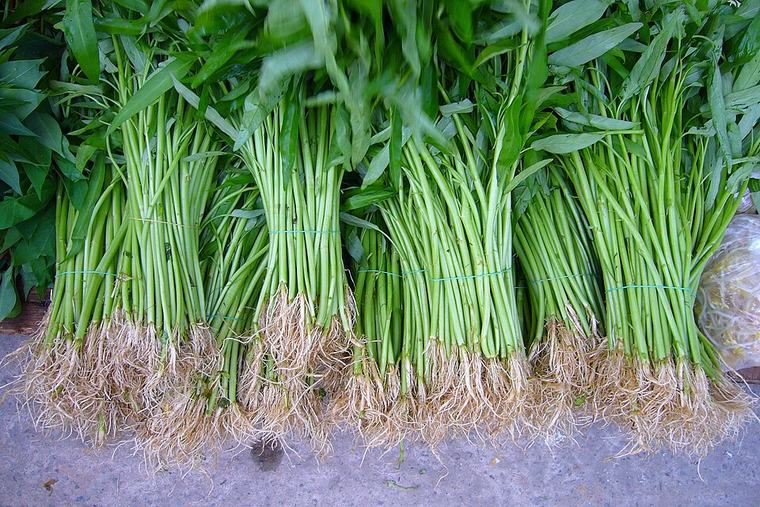
Water Spinach — Big Leaf White Stem Varieties

Water Spinach — Big Leaf White Stem Varieties
Water Spinach — Big Leaf White Stem VarietiesEric in SF / Wikimedia Commons / CC BY-SA 4.0

Water Spinach — Big Leaf White Stem Varieties

Water spinach (Ipomoea aquatica), also known as kang kong, water morning glory, and ong choy, is one of the most productive leafy vegetables in tropical and subtropical horticulture. Widely consumed across Southeast Asia, East Africa, and parts of Latin America, it produces more edible biomass per square foot than almost any other leafy green in warm climates.

Botanical Identity

Botanical name: Ipomoea aquatica Family: Convolvulaceae (morning glory family) Relation: Closely related to sweet potato (Ipomoea batatas); distantly related to ornamental morning glory

Big Leaf White Stem Varieties

The "Big Leaf White Stem" type is the most productive and most commonly cultivated variety group for food production:

  • Stems: Hollow, white-stemmed; up to 18–24 inches long
  • Leaves: Large, arrow or heart-shaped; vivid green; 3–5 inches across
  • Flavor: Mild, slightly sweet; tender when young; stems have pleasant crunch
  • Growth rate: Extraordinary — new shoots ready to harvest every 7–10 days in peak growing conditions

Other types:

  • Narrow Leaf / Green Stem: Smaller leaves, green stems; slightly more peppery; better adapted to drier conditions
  • Red Stem: Ornamental and culinary; anthocyanin-rich stems

Growing Requirements

Climate: Warm-season tropical crop. Thrives in temperatures of 75–95°F. Not cold-hardy.

Water: Semi-aquatic — grows in water 4–10 inches deep (traditional floating garden culture) or in moist, wet soil. Will also grow in standard garden beds with consistent heavy irrigation.

Soil growing method:

  • Plant in rich, consistently moist garden soil
  • Water deeply and frequently — never allow soil to dry out
  • Space 12 inches apart; pinch tips to encourage branching

Aquatic growing method:

  • Plant in containers in 4–8 inches of water (pond or water tank)
  • Stems root wherever they touch water
  • Extremely productive in this system

Propagation: From stem cuttings (most common) or seed. Take 6-inch cuttings; plant in moist soil or water. Roots in 7–10 days.

Harvest and Cuisine

Harvest: Cut tender growing tips (top 6–8 inches); the plant regrows from nodes below the cut. Harvest every 7–14 days throughout the growing season.

Asian cuisine preparations:

  • Stir-fried with garlic: The classic — high heat, garlic, soy sauce or shrimp paste
  • Blanched: Briefly boiled, served with oyster sauce (kang kong oyster sauce — Vietnamese, Thai, Malaysian)
  • Soups and curries: Added at the last moment to retain texture
  • Raw: Young tips eaten fresh in salads (mild varieties)

Nutrient Content

  • High in vitamin A, C, B vitamins, iron, and calcium
  • Protein: 2–3% of fresh weight — higher than most leafy greens
  • Traditional medicine uses: diuretic, anti-inflammatory

The Fruitful River Bank

Ezekiel 47:12 envisions trees on both banks of the river — leaves that do not fade, fruit that is not consumed. Water spinach, growing along wet margins, harvested repeatedly without exhausting the plant, is a humble earthly illustration of the inexhaustible provision God designs into creation.

The first three of this lesson's 10 questions

What is the botanical name for water spinach / kang kong?

  1. Spinacia oleracea
  2. Basella alba
  3. Ipomoea aquatica
  4. Ipomoea batatas
Show the answer

Answer: Ipomoea aquatica

What plant family does water spinach belong to?

  1. Amaranthaceae
  2. Convolvulaceae (morning glory family)
  3. Brassicaceae
  4. Asteraceae
Show the answer

Answer: Convolvulaceae (morning glory family)

What is the distinguishing physical feature of Big Leaf White Stem water spinach stems?

  1. Hollow, white stems up to 18–24 inches long
  2. Solid, fibrous stems that can be dried
  3. Thin, wiry stems that require trellising
  4. Red-streaked stems with prominent nodes
Show the answer

Answer: Hollow, white stems up to 18–24 inches long

Another 7 questions follow in the lesson itself, each one graded the moment it is answered.

What comes with the download

180 full lessons

Across 15 units, each with objectives, a teaching passage written to be read aloud, guided practice, and homework.

1,800 quiz questions

Graded the instant they are answered, each with the explanation of why that answer is right.

A gradebook that works

Every score kept, a running average maintained, and a breakdown unit by unit — all in the file itself, nothing sent anywhere.

Progress and attendance

Tick lessons off as they are finished, watch the completion bar fill, and mark days present, absent, or excused.

Report card and certificate

Both printable, with your student's name, the grades, and the dates already filled in.

Backup you control

Export every record to a file you keep, and read it back later. A lost browser cache cannot take the year with it.

An answer key

Hidden from the student by default, there for the parent marking the work.

Nothing that phones home

No ads, no affiliate links, no analytics, no fonts fetched from elsewhere. Unplug the network cable and every one of these files still works.

What you will need

Drawn from the materials named across all 180 lessons of this course. Most families already own most of it.

No lesson in this course names a material of its own, so there is nothing to buy before you begin. The Grade 12 supply list gathers what the rest of the year needs.

Download Botany & Gardening — Grade 12

Free, and free of everything else. 17 files, 57.2 MB in total. No account, no email address, no payment. What you download carries no advertising, no affiliate links and no tracking of any kind.

Photo credits

Every photograph on this page is used under a free licence, and is credited here as that licence requires. Photographs are part of the curriculum itself, so they travel with the download as well.